Wednesday, April 7, 2010

My Growth


http://www.gracc.or.kr/data/downfile/%EC%83%88%EC%8B%B9.bmp
Ideas and Content
For the Alchemist essay, I am aware that my writing skills weren't satisfactory. I strayed off from the topic casually and didn't really have any outstanding or effective ideas to support my thoughts. So I can not really find any examples that shows appropriate ideas and content. However, I can find infinite examples that lack contents and ideas. The main reason for my lack of ideas was because of the weak quote I chose. Frankly speaking, while I was looking for quotes, I just picked any quote that would be able to support my ideas and not see the depth of it in the actual story which caused my ideas to be weak too. For the Julius Caesar, I have improved. The main reason why I failed the Alchemist essay was because of the quote, but for the Julius Caesar essay, my quotes were strong and had depth in it. For that, I could express my ideas as much as I want and effectively write it so that the reader would be able to understand my ideas thoroughly. However, my Julius Caesar also had several flaws. The main mistake that cut off some grades were because of simple grammar problems. If I had looked back at my essay thoroughly enough, I would have been able to cover those mistakes and earn a better grade.
Organization
For the Alchemist essay, my organization wasn't bad, but wasn't good either. I had tried to mention my ideas according to the stories chronological order but couldn't seem to organize my ideas so that the reader would easily understand what I am trying to say since the teacher who had graded my essay was often lost.
For the Julius Caesar essay, I have mentioned my ideas in an organized manner and knew where to focus on important parts of my essay. My use of transitions were fair. Additionally, by stating a clear and focused topic sentence supported by an appropriate quote, I was able to list my ideas in an organized manner.
Personal Growth
There is an obvious growth between my essays. It clearly shows is my grade of how much I've improved in writing skills. The depth of my ideas have become exceedingly deeper and the ideas are layed out in an organized manner for the reader to easily read it. The quotes that I chose were significant compared to the Alchemist quotes which proved that I understood the significance of certain quotes better than before and whether it would contain enough information so that I can express my idea more clearly. Additionally, less grammar mistakes are made and my sentence structure is firm. My ideas stay focused on the topic, and most importantly, I have exceedingly imporved in wrapping up my ideas in my conclusion, which I have absolutely failed in the Alchemist essay.
SLR Reflection
The SLR I have represented in both of my essays were 'reason critically.' I needed evidence to prove to myself and to the reader that the quotes I have chose are significant and my ideas make sense. Another SLR that I demonstrated was 'communicate effectively' since writings are all about communication between the writer and the reader. In order to help the reader to understand his or her ideas, the writer must provide evidence and express her ideas efficiently and not flow away from the topic. I may have not be an ideal model to express the SLRs but I have tried my best.

Wednesday, March 31, 2010

Brutus's Pride As Well As His Flaw

http://www.elanso.com/ArticleModule/Compare.aspxArticleID=NiRbHlRRSiTDKUVwJXQcHvIi

Brutus’s Pride As Well As His Flaw

“For Brutus is an honourable man, so they all, all honourable men.” (Act 2, Scene 2, Lines 80-81) The following quotation was when the conflict between Antony, Caesar’s loyal supporter and Brutus, the conspirator’s leader began. Antony sarcastically described and explained Brutus as a honourable man, and that he was a true patriot. Brutus’s patriotism and honour were the two factors that made the readers have a positive bias towards him in the beginning of the play, and also the factors that led him to his death in the end.

Brutus was a character that deserved sympathy. The motivator that made the first stepping-stone to his death was non other than his strong and loyal patriotism. According to Mark Antony, he was the only conspirator that had truly loved Rome, and did not assassinate Caesar because of jealousy of his success. Brutus and Caesar were friends. However, Brutus’s ancestors were the ones that had driven away the corrupted kings of Rome and had made Rome a republic, and Brutus wanted to keep it as it is, for it was a memento of his ancestors. He knew was well aware that Caesar could become ambitious and lead Rome to another depraved kingdom. Additionally, persuaded by Cassius, one of the conspirators, Brutus has decided to join the conspiracy for Rome’s sake, and not his own. “It must be by his death, and for my part, I know no personal cause to spurn at him, but for the general. He would be crown’d.” (Act 2, Scene 1, Lines 10-13) The preceding quotation was when Brutus had an inner conflict of whether choosing his friend’s life or Rome. In the end, he came up with the conclusion that only killing Caesar shall save Rome from tyranny, and had joined the conspirators. Brutus believed strongly that killing Caesar would be ‘justice’ for Rome, for humans become arrogant when they had reached the top, and tend to ignore the ladder that had helped him to reach there. Brutus feared that Caesar might make his supporters and the other citizens of Rome as his slave and become a tyrant. Brutus didn’t join the conspiracy only because he was afraid of tyranny. He had another reason, his love towards Rome, which was a peaceful republic. “Not that I loved Caesar less, but that I loved Rome more.” (Act 3, Scene 2, Lines 20-21) This quotation was part of Brutus’s speech to justify his and the conspirator’s assassination of Caesar. He mentioned that he had loved Caesar, but his love towards Rome was more powerful. This shows that Brutus truly loves Rome and is a loyal patriot to his country for he even killed his friend for what he thinks will be beneficial for his country. The fact that Brutus even killed his friend for his country shows how much Brutus loved Rome, and how powerful and stiff was his patriotism.

By showing his patriotism and being born into a noble family, Brutus’s theme or title was ‘honourable,’ and Brutus himself, also had great pride in his title. However, this ‘honour’ was also his greatest flaw that led him to his death. “Believe me more mine honour, and have respect to mine honour, that you many believe. Censure me in your wisdom, and wake your senses, that you may the better judge.” (Act 3, Scene 2, Lines 14-17) This quotation was presented in the play when Brutus talked to the crowd about the conspirator’s deeds and to manipulate them to think that the conspiracy was justice. Brutus emphasizes his honour in his speech making the viewers and the crowed to feel like as if his honour is a great deed and should believe what Brutus says for he mentions his honour in it. The quotation also shows shows that once more, Brutus thinks of his honour as everything and believes that his honour shall succeed in manipulating the crowd. However, his honour was not only his pride, but also his biggest flaw. “And for Mark Antony, think not of him; for he can do no more than Caesar’s arm when Caesar’s head if off.” (Act 2, Scene 1, Lines 181-183) This quotation was part of Brutus’s speech to persuade the conspirators to not kill Antony for their behaviours may look to bloody and violent, and ‘violent’ doesn’t suit an honourable and noble figure like Brutus. Although Cassius presented the idea of killing Antony, Brutus considered Antony to be only a limb of Caesar, and made the conclusion that he will be no threat as long as Caesar was gone. This quote shows that Brutus knows how to respect his enemy’s supporters and is aware of when a cause might seem to bloody. This quote might make the readers think that Brutus is really worth respecting and is a generous figure. However, his honour of respecting Antony was the greatest mistake he could make in his life, for Antony completely flips the crowd’s faith towards Brutus by talking to them as if he was an equal and turns around the crowd’s bias of the assassination of Caesar.

The conflict between Antony and Brutus’s bias of Caesar’s assassination switched Brutus’s dignity into his flaw. His patriotism was the origin of him joining the conspiracy and his honour was the main cause of him making the biggest mistake of his life, to let Antony live. If Brutus had agreed with Cassius to kill Antony, his goal would have been achieved wholly. However, because he ignored Cassius’s advice because of his honour he accomplished his goal partially, for Antony and Octavius (Caesar’s son) declared war against the conspirators, making Rome a bloody battlefield, and crucially, Octavius has became the king, following Caesar’s dream. Even though Brutus achieved his goal partially, I would say that his goal was noble. Brutus’s primary goal was to save Rome from tyranny and to maintain his ancestor’s achievements. He has killed his friend and until the end, believed that he did what was right for his country and died a honourable death.

Monday, March 29, 2010

The Lost Boy's Plight

Think Creatively!
The part that I've thought creatively in this collage is the outer line of the images pasted. I have added some positive feelings into some images which showed the peaceful life and hope for the lost boys by making the outer line curvy and smooth. And, for harsh situations that had made the lost boys suffer, the lines are ripped apart to show negative expressions. Another thing that I have thought creatively is to lay out the images in order to show the life of the lost boys in chronological order to exactly show the plight of theirs.

Reason Critically!
I reasoned critically when choosing my images. I needed to make sure that all of the images on my collage relates directly to the journey of the lost boys and stay focused on the topic. Also, I needed to add some emotions in my collage to persuade the viewers to take some actions. I needed evidence to support my thoughts and sympathy so that the viewers would believe what the collage shows.

Communicate Effectively!
I communicated effectively by using appropriate and effective pictures and laying out the images in order. Rather than pasting images in random order, sticking them in order would help the viewers to understand more effectively about their plight. Additionally, about the outer lines of the images, I am additionally able to show the emotions of not only myself, but of the lost boys too.

Live Ethically!
By showing sympathy of the lost boy's past I have demonstrated how to live ethically. I understand well that the lost boy's lives were very desperate and sad and truly feel sorry for them. Additionally in my collage, I have posted how the U.N was to Sudan when the civil war occurred and their response has caused Sudan to fall.


Sunday, March 14, 2010

Peter, the Lost Boy

The Lost Boys of Sudan are a group of over 20,000 refugee boys and girls, age range of 7 to 17. They have lost their parents during the civil war, and on their journey to Ethiopia many have died due to starvation, sleeplessness and diseases. The few that have survived are now currently in refugee camps in Kenya, Sudan, and Uganda. And among the 20,000 refugees, only 4000 of them has been chosen to experience a 'civilized' life in America. Peter is one of the 4000 boys that were selected. He was an open-minded figure who was willing to adapt the culture of America which was new to him. However, it wasn't that easy.

Even though the world claims that everyone has equal human rights regardless of their race and skin colour, there are still those who refuse to accept people who are different from them. And Peter was one of those who were treated differently because of his skin colour. At his working place, he was assumed by his boss that he would endure the hot sun better than the white people since he is black. Even the his school counsellor who is supposed to be in charge of helping the student to his satisfaction underestimated him because he's a refugee and he's black and chosen all of his classes even before Peter had a chance to talk to him. Not only racism, but Peter also faced some financial problems too. His relatives back in Sudan kept on acquiring money from him even though he didn't have enough money to survive himself in America. He needed to pay for his rent, food and everything else. But the worst case for Peter was his sudden low self-esteem. Compared to the rich whites who had parents and proper education, he felt so weak and poor compared to them. He was a refugee, his parents were killed during war, he earned his own money, and lastly, he didn't have proper education as them. He felt that he was different from the people in the civilized world, and felt that he does not fit into this group.

The situations above naturally leads to cultural shock. Peter came from an uncivilized refugee camp, and America is one of the most civilized countries in the world. With such a big cultural difference, one cannot adapt the new condition there in unless they receive help or guides from others who are used to this culture. However, Peter was rejected by the whites because of his race and was left to adapt the new world alone.

Thursday, February 18, 2010

[Julius Caesar]Performance Assessment

Partner: MinJin, Kim - as Decius
Me - as Caesar

Passage: Act2,Scene2, lines 65-107

CAESAR
Shall Caesar send a lie?
Have I in conquest stretch'd mine arm so far,
To be afraid to tell graybeards the truth?
Decius, go tell them Caesar will not come.

DECIUS BRUTUS
Most mighty Caesar, let me know some cause,
Lest I be laugh'd at when I tell them so.

CAESAR
The cause is in my will: I will not come;
That is enough to satisfy the senate.
But for your private satisfaction,
Because I love you, I will let you know:
Calpurnia here, my wife, stays me at home:
She dreamt to-night she saw my statua,
Which, like a fountain with an hundred spouts,
Did run pure blood: and many lusty Romans
Came smiling, and did bathe their hands in it:
And these does she apply for warnings, and portents,
And evils imminent; and on her knee
Hath begg'd that I will stay at home to-day.

DECIUS BRUTUS
This dream is all amiss interpreted;
It was a vision fair and fortunate:
Your statue spouting blood in many pipes,
In which so many smiling Romans bathed,
Signifies that from you great Rome shall suck
Reviving blood, and that great men shall press
For tinctures, stains, relics and cognizance.
This by Calpurnia's dream is signified.

CAESAR
And this way have you well expounded it.

DECIUS BRUTUS
I have, when you have heard what I can say:
And know it now: the senate have concluded
To give this day a crown to mighty Caesar.
If you shall send them word you will not come,
Their minds may change. Besides, it were a mock
Apt to be render'd, for some one to say
'Break up the senate till another time,
When Caesar's wife shall meet with better dreams.'
If Caesar hide himself, shall they not whisper
'Lo, Caesar is afraid'?
Pardon me, Caesar; for my dear dear love
To our proceeding bids me tell you this;
And reason to my love is liable.

CAESAR
How foolish do your fears seem now, Calpurnia!
I am ashamed I did yield to them.
Give me my robe, for I will go.


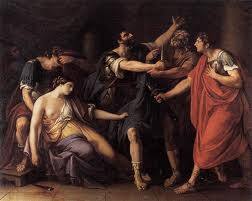
The following scene is when Caesar decides to stay at home as Calpurnia wished him to for she fears that Caesar is going to be killed as she dreamt. However, Decius turns out and starts to flatter Caesar to come to the capitol as he planned with the conspirators.
This passage has a few significance in it. Starting with the dramatic irony. The viewers and readers know that Caesar is going to be killed when he reaches the capitol and gets out of his house, and just when Calpurnia managed to find a way to save him, Decius comes along taking that chance away. However, when Caesar claimed that he shall not go, it gives tension in the play and makes the audience think in a different perspective whether Caesar shall be killed or not. Not only making the audience think in a different way, but it also adds some personal feelings in the play such as sympathy or anger towards Caesar's innocence. Another significance is that this is the scene that decided Caesar's fate. The moment he was flattered by Decius to go to the capitol with him, it became sure to the audience that the conspirators shall succeed in their conspiracy and assassination and Caesar shall meet his end.

Sunday, November 29, 2009

School of Athens


How can art be a mirror of the society?


During the Middle Ages, no artists has used a secular topic for their painting, or used techniques that the Renaissance painters have used, such as linear perspective, shade and light, foreshortening, focusing on backgrounds, using a secular topic, and many more. It can be seen that paintings depend on artist’s knowledge, and artist’s knowledge depend on the dynasty or the time they were living in, and how much that time of age is developed in certain techniques, knowledge, methods, etc. Additionally, art shows the current situation the artist was living in. Such as ingredients that were used in the painting, the mood, the focal point, and many more are hints of the art piece of what it is trying to show. Also, paintings such as the 'school of Athens,' by looking at the picture, the viewers can infer than during the time that Raphael painted this piece, many scientists, philosophers were born and how they tried to seek science and facts.


If I were an individual in the painting ‘The School of Athens’, I would be Heraclitus, which is the man that is leaning on a desk in the bottom middle side of the painting. Heraclitus was a Greek philosopher that criticized predecessors for their failure and to see the unity in their failure. He and I are similar in ways that we both criticize others for their failures to encourage them to see their failure as an experience and not to make the same mistakes again. Additionally, Heraclitus is known for being logical and sending out theories of his own, such as ‘opposites are identical,’ ‘everything is and is not at the same time,’ etc. Similar to Heraclitus, I also reveal my ideas and theories that I think are true to other and seek only logical and scientific facts rather than superstitions and beliefs.

Friday, October 23, 2009

Leornado Da Vinci, A True Renaissance Man


"Renaissance" means 'rebirth.' The rebirth refers to arts, architecture, and attitude of artists and scientists toward new knowledge and ancient methods. During the Renaissance, the church had most of the power, and the church refused to share knowledge to any others in fear if people starts to think scientifically and logically instead of gods and spirituality which will cause them to loose faith and power. Da Vinci was one of the men and a major one that caused this 'rebirth' during this era. He made alot of masterpieces and beautiful artwork, additionally, weapons and tools that used science and were made logically. He was a stepping stone in the Renaissance to science and was a true Renaissance man by practicing the 'rebirth.'


http://991.com/newGallery/The-Children-Rebirth-330512.jpg

Wednesday, September 30, 2009

Messy Room-"Do I Have the Rights?"

Messy Room by Shel Silverstein
Whosever room this is should be ashamed!His underwear is hanging on the lamp.His raincoat is there in the overstuffed chair,And the chair is becoming quite mucky and damp.His workbook is wedged in the window,His sweater's been thrown on the floor.His scarf and one ski are beneath the TV,And his pants have been carelessly hung on the door.His books are all jammed in the closet,His vest has been left in the hall.A lizard named Ed is asleep in his bed,And his smelly old sock has been stuck to the wall.ll.Whosever room this is should be ashamed!ll.Whosever room this is should be ashamed!Donald or Robert or Willie or‐‐ll.Whosever room this is should be ashamed!Donald or Robert or Willie or‐‐Huh? You say it's mine? Oh, dear,ll.Whosever room this is should be ashamed!Donald or Robert or Willie or‐‐Huh? You say it's mine? Oh, dear,I knew it looked familiar!

The poem is about a person that blames another even though he isn’t any good himself. Shel Silverstein made his opinion clear in a very amusing way. The statements that are in his poem are very often mentioned in our daily lives, and we are familiar with it. The person that usually hears “Tidy up your room,” are kids and teenagers and the person that usually says it are our mothers who naturally has the right to say that since they’re all tidied up first before scolding someone because of their mistakes. However, hilariously, Shel mentioned a “foolish” person that distinguishes the looks of a room, not knowing that it is actually his or her own. She Silverstein is trying to claim to all that before scolding another, think before acting, “Do I have the right to say something to this person? Am I appropriate for a model for that person’s mistakes?”

Saturday, September 26, 2009

Faith's colours


Gerhard Richter, Passage

Faith shatters between two friends
The pure white silk it wore dyes into dark raven
Never to let go of one’s heart


In the novel Alchemist, the protagonist, Santiago gets robbed during his journey by the one which he believed was his friend. His faith was shattered into pieces by the moment he decided to believe him. If the faith between the two friend’s first colour was pure white, because of the betrayal, it would have turned into dark raven. Normally, the colour white refers to pureness and cleanness; however, colours like dark raven refer to betrayal, hatred, sorrow, loneliness, and death. Santiago’s heart to his friend was pure and it could be seen as he waited for the man to appear for quite a long time, saying to himself that “his friend is lost and will also be finding for him.” However, no matter how he held on to his faith, he couldn’t resist the truth forever. His faith and heart turned into black towards the friend and would never fade until someone else appears with sincere trust towards him.

Wednesday, September 23, 2009

Sanguine:A tool for brightness

* Pierre Bonnard, Dining Room on the Garden

Yoon‐Jo, Park
Hum.Pink
Ms. Smith

A Model for Our Lives


“Well, I’d like to see their land, and see how they live.”(Coelho 9)
Santiago, the protagonist in the novel ‘The Alchemist,’ is a boy who seeks to travel, and the destiny of his is also to travel. Santiago’s parents wanted him to become a priest, but he insisted and became a shepherd for his nature was to be free and soar around the region. He starts to have weird dreams continuously and realizes that it’s a sign from the gods to admit his destiny and seek places that he has never known. Santiago’s characteristic could be described as courageous, adventurous, and wise.

“When ever he could, he sought out a new road to travel.”(Coelho 10)
When Santiago first figured out that he was fated to travel to a new land that he had never known before, he didn’t hesitate because of fear but because of the woman he loved and the life he had already achieved in Andalusia. Normally, it takes great courage to decide to travel alone without any aids at first. Additionally about the Alchemist. The first impression of the Alchemist was a fearful, dangerous character. He pointed his sword to Santiago driving him to the edge asking questions that only someone that understands certain omens from the god can answer. However, Santiago didn’t show his fear to the Alchemist and claimed everything that he knew without hesitation. Even at the most dangerous moment of his life, Santiago managed to put himself together and this kind of acts of Santiago is indeed courageous. By being courageous, he was able to overcome many obstacles during his journey.

“Because I like to travel.” (Coelho 21)
That was what Santiago replied to Melchizedek when he asked why he became a shepherd. He was adventurous, and because he liked to travel, he could make his decision soon after he received his destiny. If not, he could’ve hesitated to decide whether he would go for weeks and months, or even worse, refuse the call to the adventure. It was his dream to travel around the world and know stuff that he didn’t know about. He wanted to understand how the others lived and seek through out the parts of the world he didn’t know. Because it was his dream, he could still go forward even though he faced many obstacles during his journey.

“I have watched the caravan as it crossed the desert. The caravan and the desert speak the same language, and it’s for that reason that the desert allows the crossing.”(Coelho 75) When Santiago first set up his foot to begin his journey, he was helpless and completely blank about the language of the world, soul of the world, or even how the region Africa was like. After spending several months in Africa, he widened his knowledge about the world shockingly swiftly. Santiago was able to understand the soul and language of the world and could even stand out phrases that proves that he is worthy of receiving the destiny. Not only he understood the soul and language of the world, but he was accepted by the Alchemist who can be referred as one of the wisest man around and was pointed as his apprentice. Of course he did have some help around but mainly he ended up solving his own problems on his own by using his own wisdom.

Santiago is truly appropriate character for a protagonist who is seeking his goal and achieving it. By being courageous, adventurous and wise he could accomplish his goal to seek the treasure and by being responsible he could win Fatima’s love and earn a new life with a lover. Paulo Coelho made Santiago a model for our lives. Santiago is a type of character will all the aspects of people would like. Not giving up on goals, being courageous and responsible. Coelho would've liked to show the readers of his book how people can be shown if they have certain characteristics like Santiago and to tell them to not give up even in the most dangerous lethal situation they could get and eventually, you will end up with fortune.

Sanguine: An tool for brightenss

Being sanguine is an essential characteristic for seeking destiny. You can’t always say that everything will turn out easily and smooth. Sometimes there will be challenges and obstacles that will put me to despair or depress me badly. If someone seeking his destiny is sanguine, he will easily be able to overcome the depression of failing and be able to set up foot and challenge himself again to his destiny. I am generally a sanguine person. I easily forget sadness and become cheerful again such as I don't get frustrated or sad about conflicts with other people or with something that irritates me so bad such as getting low scores or getting scolded by teachers. I quickly get over the frustration and try again to approve meyself to other and by this I was able to achieve quite a few goals with my sanguine characteristic. However, being sanguine is not always appropriate. Being sanguine continuously could easily be thought as ‘stupid.’ Being sanguine acquires consideration every time.

Sunday, May 24, 2009

Responsibility: A Vital Morality


I believe in responsibility.


image/http://runningthroughrain.files.wordpress.com/2007/08/global-responsibility.jpg

I chose this image because the hand has responsibility to protect and hold the Earth. Also, if we keep the most basic morality the Earth could be kept clean and safe.

Cassiopeia

Sunday, May 10, 2009

Matt around the world

Matt did a wonderful job on showing his idea that the world is connected. When I first saw the video clip, I couldn’t understand what he was trying to say. I could only see a man dancing weird and awkwardly all around the world, and in the end, people started to join him. I briefly got the idea when I saw the video clip thrice but I was still confused. ‘Is he trying to show that all people are the same? Or is he trying to infer that everyone feels the same way?’ After a few minutes, I finally realized all these things that I was thinking about can be considered as one word, ‘connected.’

Nobody in the world is same with another. Everyone has their own characteristics, race, skin color, looks, personalities, etc. Despite of that, we all have the same heart to feel and emotions to be understood. Matt said in his essay ‘Here's what I can report back: People want to feel connected to each other. They want to be heard and seen, and they're curious to hear and see others from places far away.’ That part really touched me. Everyone is curious about people that they don’t know about. He danced with people that he didn’t know well. They were different race, and didn’t even speak the same language with him. However, he ignored all of those differences and only thought about the fact that they and he is connected. They could dance together, and now that video clip has been watched by more then million people in the world, giving the others to think about the feeling that he got by his experience.

Monday, April 27, 2009

A Gem Covered In Dirt


I realized that still most people judge people by their appearance. Susan Boyle had a dream to become a singer. When she first approached and claimed about her dream, everyone, even the judges laughed at her. I, too also thought ‘Oh my gosh, how could she even think of coming out to the stage with a face like that? She looks to old and heavy. She won’t even be able to pass the first round.’ Susan Boyle will also have known why the people laughed at her. But, she didn’t look disappointed. She kept her foot above the stage rather running away. When she started to sing everyone’s jaw opened with astonishment and surprise. Her voice was beautiful and magnificient. It made me ashamed and embarrassed by not noticing and respecting her talents.

Everyone always think that ‘every people have the same right, and pride to themselves’, but hardly everyone think of that when they come to a situation when they think that they are better than someone else. Such as nationality, age, skin color, wealth and even appearance. And they think just because of a tiny detail about them, they tend to ignore or look down upon anything about them. We need to stop judging people and look inside of them whether to check they are truly low-lives and deserved to be looked down upon.

The poem ‘Dream Keeper’ kind of links to Susan. The poem is saying ‘bring me all of your dreams….’ to the readers like a god or a consciousness. Everybody becomes nervous to stand upon a stage with a crowd so large at their first time. But, some people win that feeling by keep on telling themselves something hopeful after they can overcome this obstacle. Personally, I have high pride, and if someone laughed at me because of being on stage, I could’ve threw the mike away and shout in front of him no matter if it’s on air or not. However, Susan just went over it, and even kept on entertaining the audience. It was her dream for her life so she wouldn’t just send this opportunity.

The similar thing happened to Paul Potts, the 2007 winner. He was fat and unattractive very similar to Susan Boyle. He was a salesman, and when he said he wanted to do opera, everyone laughed the same. However, he was very, very talented. Seeing Paul and Susan, we need to realize that no one has the right to judge people but everyone has the right to become whatever they want.

Cassiopeia

I am…


I am a wave crashing rocks from the sea
Smooth but powerful enough to break huge rocks
Into tiny pebbles

I am a hug, warm as a blanket in a frosty winter night
That makes people comfortable and loved

I am a maze scribbled with dark green branches
Complicated, twirled and unknowable

I am the rising sun above the blue sea
Hope for the ones that love me

I am the bloody ocean of roses
that symbolizes
Passion and beauty


I am Cassiopeia dazzling and radiant
Always shining in the sky
Protecting the five that I love

I chose the image 'dusk' because although I can be
greyish and dusky like the background, I am
also red and passionate.
http://www.guggenheim.org/new-york/collections/collection-online/show-full/piece/?search=Dusk&page=&f=Title&object=59.1544

Wednesday, December 3, 2008

Fox's theme


In the page that fox first appeared, he had bloody evil red eyes, staring at magpie and dog as if it wants to break them apart. After that, the fox starts to creep towards them and starts talking sarcastically. "I saw you running this morning. You looked 'EXTRAORDINARY.'" And not only that, he kept on disturbing magpie and the dog when they were talking together. Finally, he ends up trying to break the relationship between magpie and dog. He continued to suggest that he can run faster than dog and asks 'Do you remember how is it to fly? TRULY FLY?' Then, magpie starts to think about it. She was desperate to have the feeling of TRULY flying again, and ends up betraying dog. At first,

Monday, November 24, 2008

Kafka's statement


‘A book should be an ice-axe to break the frozen sea within us’
-Franz Kafka


The moment I saw Kafka’s statement, several ideas popped inside my head about what the statement means. But I think the most precise idea to the real meaning of the statement in that the ‘frozen sea’ is our frozen or stunned imagination, and the ‘ice axe’ refers to the tool that can defrost it. The human brain develops only when it’s used. Imagination and knowledge from books are a shortcut to fuel our brain.
Before I read the ‘Warriors saga,’ I didn’t even see a page of an object called ‘book.’ After my’ soulmate’ (or my BEST friend) MinHee started to read this book, I started to have some interest in it. She had that book in her hand the whole time. If I asked, “Do you like me or the book?” She would have said, “Book.” The book cover’s background was dark, and it kind of gave me a feeling that my imagination or knowledge about books was like that. But, the cats on the cover seemed to move and wander around with their shimmering pelt, brightening their pitch-black surroundings. Maybe that’s why I was attracted to this book. It was mirroring my imagination. It’s dark, but there is light. It’s dark, but there’s hope. Hope for me to become creative and improve my imagination. I started to read the book. One book was over 400 pages, and there were total 6 books in the saga. Astonishingly, Park Yoon Jo, a girl that didn’t even read a single book in a year, finished the whole saga in 4 days. After that unbelievable (?) event happened, I became a humorous kid. I started to say out things that normal people couldn’t ‘imagine’. I broke the frozen sea within me.

Thursday, October 30, 2008

Plastic Glass!


Dolphin shaped plastic glass


By, MIROTIC-_-V


Plastic glass. It might sound pretty cheap and pathetic to you, but surprisingly, it shows me pretty well.
7 years ago,My father gave me a dolphin shaped plastic glass that contains blue liquid and a rice that has my name written on it.
When I was about 7 years old, I was mad about the ocean, and the creatures that live there, and especially dolphins. I only read books about dolphins, searched images and information about it in Internet, and even switched my mother’s cell-phone’s background to the ocean. If I told you this much, you’ll be able to predict what color I like the most. BLUE!! As I told you from above, there is a BLUE liquid inside the plastic glass. I think those two show pretty much what I like.
In addition, I said there’s a rice with my name on it right? Korea’s main dish is rice, and most of all, I LOVE rice, especially plain white rice that is recently cooked.
Moreover, The plastic glass and the blue liquid show my personality. If someone swears or say bad things about me, I pretend that I don’t care or swear back at them to not loose and try to look tough like the plastic glass that doesn’t break easily. But, in the inside, like the weak liquid I’m not as tough as I look in the inside. I get easily hurt.
Finally, last of all, the most important part, it has MY NAME IN IT. What would show me better than my own name on it? I bet you can’t find anything better that shows me.